

Green Creek Environmental Technology Co., Ltd. - Technological Advantages
Published Time:
2020-12-11

Evolution of GMBR Technology
In 1914, Ardern and Lockett in the UK pioneered classic biological treatment aimed at BOD5 removal and complete nitrification. Limited by secondary sedimentation tank solid-liquid separation, MLSS was only 2~4g/L.
In 1980, Barnard in the US introduced the mainstream AAO process for nitrogen and phosphorus removal, standard with a secondary sedimentation tank, maintaining MLSS at 2~4g/L.
In 2000, Zenon Company in Canada spearheaded the large-scale commercialization of MBR, increasing MLSS to 6~10g/L. However, the membrane module lifespan was only 3~5 years, and offline cleaning was difficult (for a treatment scale of 50000m3/d, offline cleaning took at least 1 month, and labor for lifting/resetting/manual cleaning was ≥2000 hours).
In 2008, the Kyoto Membrane Core Factory in Japan secretly launched a pilot test of GMBR (i.e., Greenclean Membrane BioReactor). Ten years of meticulous craftsmanship and five iterations of refinement resulted in high-quality technology.
In 2018, Greenclean (our company), adhering to Industry 4.0 standards, globally launched and mass-produced GMBR. The membrane module lifespan is ≥20 years, MLSS can reach 10~20g/L, offline cleaning is unnecessary, simple online cleaning ensures long-term stable operation, and labor is ≤10 hours.
The core of the GMBR process is the mature and reliable AAO process combined with advanced CPVC flat plate membrane components. Using membrane component mechanical retention to achieve complete separation of HRT and SRT, decoupling the contradiction between nitrogen removal and phosphorus removal, significantly improving the efficiency and stability of biological treatment. It perfectly replaces numerous structures and electrical equipment such as "secondary sedimentation tank + coagulation + sedimentation + filtration," simplifying the process flow. The regenerated effluent surpasses GB3838 surface water Class IV standards and can be directly reused for landscape or urban miscellaneous purposes.

Process Characteristics
1. The MLSS of the GMBR process is 5~10 times that of the traditional AAO process, enhancing shock load resistance, improving biochemical degradation efficiency, and reducing the biological toxicity of regenerated effluent.
2. The GMBR process independently controls HRT and SRT, directionally optimizing the nitrogen and phosphorus removal processes, and solving the problem of unstable TN and TP in regenerated effluent.
3. The GMBR process uses CPVC flat membranes designed with a Gaussian algorithm, with a concentrated pore size distribution (0.25μm). The regenerated effluent achieves "double zero" for fecal coliforms and SS, simultaneously solving the problems of high disinfection costs and difficult mud-water separation in winter.
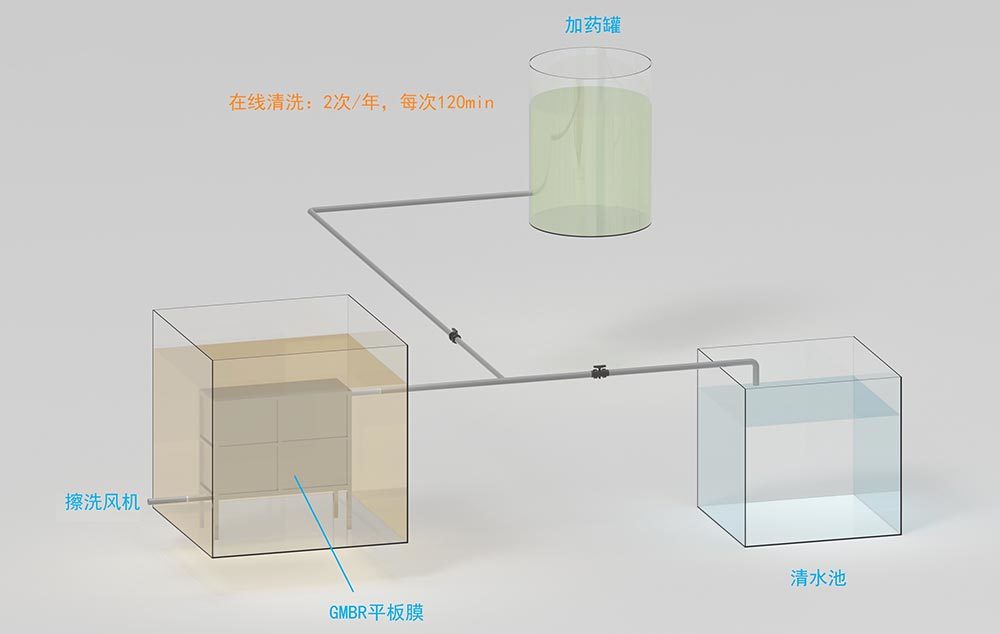
4. The GMBR process features a unique design for in-situ online cleaning. The membrane components do not require "lifting in and out" for offline cleaning, ensuring "uninterrupted water" system operation and convenient maintenance.
5. The GMBR process has a short flow, small effective volume of the bioreactor, saving land occupied by secondary sedimentation and deep treatment, reducing land use by more than 50% compared to traditional processes.

Cost Advantages
1. The GMBR has a low total life cycle cost, less than 50% of competing MBRs.
2. The GMBR has the lowest water consumption of 0.2~0.3kW·h per ton, less than 50% of competing MBRs.
Introduction to the Intelligent Manufacturing Base
The Greenclean Environmental Technology Development Co., Ltd. production and manufacturing base is located in Wuzhi County Industrial Cluster Zone, Jiaozuo City, Henan Province. It undertakes the company's environmental protection equipment manufacturing and technological research and development work, and possesses mechanized, automated, and intelligent equipment manufacturing production lines. It has an annual output of 1 million m2 of CPVC flat membrane components, which can support 500,000 m³/d municipal wastewater treatment projects; 1000 sets of integrated wastewater treatment equipment, serving decentralized plants such as villages, towns, hotels, communities, schools, and service areas.

GMBR Products
1. GMBR Membrane Element
(1) GMBR Membrane Element
The membrane element consists of a membrane core, non-woven fabric membrane pad, ABS support plate, and water intake port; the membrane core material is CPVC (modified chlorinated polyvinyl chloride), with a pore size of 0.25μm.
(2) Membrane Core Manufacturing
High-quality membrane core: Manufactured in the Kyoto factory in Japan, using "wet immersion casting + dry pore formation," with high porosity, uniform pore size, symmetrical structure, permanent hydrophilicity, high flux, low water resistance, and strong anti-fouling ability.
Detailed Parameters of GMBR Membrane Element
| Parameter Name |
Detailed Parameters |
|
| Effective membrane area (m2/piece) |
0.8 |
|
| L×B×H (mm) |
1000×490×7 |
|
| Average pore size (μm) |
0.25 |
|
| Membrane Core |
Material |
Modified Chlorinated Polyvinyl Chloride (CPVC) |
| Substrate |
PET |
|
| Support plate material |
ABS |
|
| Membrane flux (m3/m2·d) |
Domestic sewage 0.5~0.7 Industrial wastewater 0.3~0.5 Garbage leachate 0.1~0.3 |
|
| Applicable pH |
2~12 |
|
2. Advantages of GMBR Membrane Components
Standardized design, convenient expansion, high installation efficiency.
Modular design, convenient inspection, installation, and maintenance.
Integrated design, built-in membrane elements, water collection pipes, and scrubbing air ducts, high packing density.
Customized design, meeting customer's individual needs, reducing costs and increasing efficiency.
Energy-saving design, open CFD perforated air pipe, low scrubbing energy consumption.
Seven Leading Advantages of GMBR
| GMBR |
Competitor MBR |
| No membrane screen (ultra-fine screen) required, Low equipment investment, simple system configuration |
Membrane screen required (ultra-fine screen, screen spacing 0.5~1.0mm), High equipment investment, complex system configuration |
| 10-year warranty, service life ≥20 years |
1-year warranty, service life 3~5 years |
| High flux, 0.5~0.7m3/(m2·d)* |
Low flux, 0.3~0.5m3/(m2·d)* |
| Long fiber embedded crosslinking, good integrity |
Membrane lining membrane skin "sandwich" structure, easy to peel |
| Dry storage, convenient storage and transportation |
Wet storage, inconvenient storage and transportation |
| Extremely easy to clean, Online cleaning (CIP) frequency 2 times/year, 120min each time, can resume operation |
Extremely complex cleaning, Online maintenance chemical cleaning frequency 1 time/week, 30min each time; Online recovery chemical cleaning frequency 1 time/month, 120min each time; Offline cleaning frequency 3~4 times/year, each time no less than 1 month |
| Large potential for sludge reduction, Reduces emissions by more than 50% compared to traditional processes |
General sludge reduction effect, Reduces emissions by only 20~30% compared to traditional processes |
*Refers to domestic sewage flux
GMBR Application
GMBR technology has become the preferred technology for the construction of new sewage treatment plants in towns and cities, underground sewage treatment plants, industrial park sewage treatment plants, and the upgrading and expansion of old sewage treatment plants. The GMBR membrane module filters the effluent, replacing the traditional secondary sedimentation tank and deep treatment system, and the reclaimed water can achieve the high standard discharge of surface water level IV.
Intensive process, 50000m3/d scale, occupies only more than 30 mu.
GMBR integrated equipment is a decentralized energy-saving intelligent sewage treatment equipment independently developed and innovated by our company. It has the characteristics of modular skid mounting, convenient transportation, quick installation, intelligent operation, unattended operation, remote transmission and remote control, and is suitable for small and medium-sized decentralized sewage treatment in towns and villages.
Previous: